

- Record where every booked job came from. Most firms are guessing.
- Chase every open quote. It’s the cheapest work you’ll ever win.
- Finish your Google Business Profile and get reviews coming in every week.
- Make the website turn visits into enquiries, not just look nice.
- Only then pay for more leads, and judge them on cost per booked job.
This is written for removal companies that are already running: a couple of vans or more, a steady diary most weeks, and an owner who wants the quiet weeks gone and a bit more say over which jobs they take. If you’re just starting out with one van, most of it still applies, but your first job is simply getting reviews on the board.
I spent five years as a porter and driver before I started Inbound Removals, and now we only work with removal firms. The same handful of problems come up on nearly every call, so that’s what this guide covers.
1. Find out where your booked jobs really come from
Ask most owners where their work comes from and you’ll get “Google, word of mouth, bit of Compare My Move.” Ask what each one costs per booked job and it goes quiet. That’s the first thing to fix, because without it you can’t tell a good month from a lucky one.
Every time a job books, note where the customer came from. Ask them on the phone (“how did you find us?”) and put it on the job. After a month or two you’ll have a table like this:
| Source | Enquiries | Booked | Cost | Cost per booked job |
|---|---|---|---|---|
| Google Maps / website | 30 | 9 | £0 per lead | Your time only |
| Lead site | 60 | 6 | £600 | £100 |
| Repeat / referral | 8 | 6 | £0 | £0 |
| Paid Google ads | 15 | 4 | £300 | £75 |
Example figures only, to show the layout. Yours will look different, and that’s the point of doing it.
Two things usually jump out. The source with the most enquiries is rarely the one booking the most jobs, and the “free” sources are worth far more than they get credit for. That tells you where to spend your effort before you spend any more money.
2. Stop the leak: speed and quote follow-up
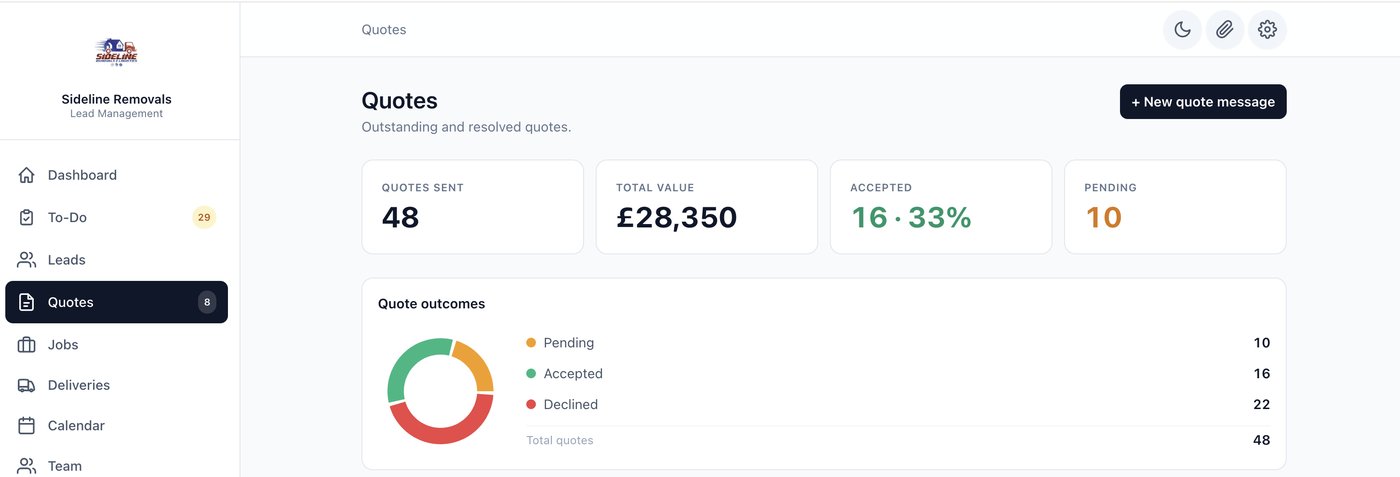
This is the one most firms skip, and it’s the quickest win there is. You’ve already paid for the enquiry, in money or in time. You’ve already done the survey or the phone quote. Then the quote goes out and nobody looks at it again.
Customers rarely say no. They go quiet, because they’re busy, they’re waiting on a completion date, or someone else rang them back first. A polite follow-up brings a surprising number of them back.
What good looks like
- Answer fast. Ring web enquiries back within minutes, not at the end of the day. If you’re on a job, a text saying when you’ll call keeps you in the running.
- Send the quote the same day, written down, with what’s included and what isn’t. Vague quotes get compared on price alone.
- Follow up after 48 hours. A short, friendly message: has the date moved, any questions, happy to hold the date for you.
- Follow up once more about a week later, then close it off so your pending list stays honest.
- Confirm bookings straight away by text, so the customer stops shopping around.
You can do all of this with a notebook and your phone’s reminders. The trouble is it’s the first thing to slip in a busy week, which is exactly when you’re sending the most quotes. That’s why we automate the 48-hour follow-up and the booking confirmation for our clients, but the habit matters more than the tool.
3. Get your Google Business Profile working
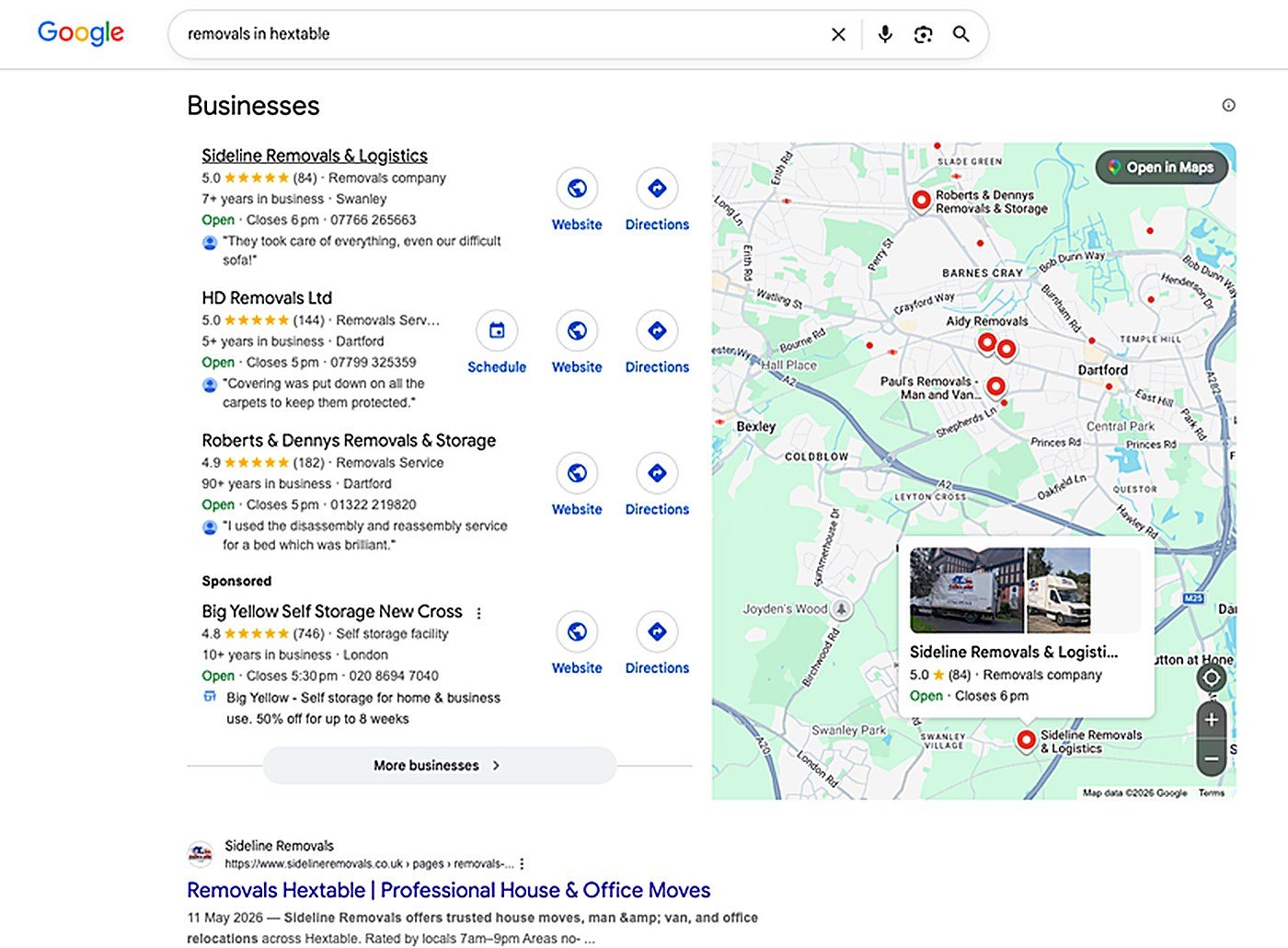
When someone searches “removals near me” or “removals in [your town]”, the map results at the top are where most of the clicks go. Those enquiries come straight to you, nobody else gets the same lead, and you don’t pay per click. For most established firms it’s the best source of work they have, and it’s usually half set up.
The basics that make the biggest difference
- The right primary category. Pick the closest removals category Google offers, then add secondary ones for the work you genuinely do, such as storage or packing.
- Your address. In our experience, a public address gets you a pin on the map and a boost for searches near your yard. Hide it and you lose both, and rely on reviews alone for wider searches. Decide deliberately, don’t leave it to chance.
- Services and service areas filled in properly, with a line on each service in plain English.
- Real photos. Your vans, your crew, your liveried kit, loaded vans. Stock photos do nothing for trust.
- Regular posts. One a week is plenty. Keep them useful (a tip, a recent job, a seasonal note) rather than salesy.
- Consistent details everywhere. Your name, address and phone number should match across your website, Facebook, Yell, Checkatrade and anywhere else you’re listed.
Reviews: the one you can’t skip
People are trusting you with everything they own, so reviews carry more weight in removals than in most trades. What matters is how many you have, how recent they are, and what they say. A firm with 120 reviews and five from last month will usually beat a firm with 40 from two years ago.
The fix is simple and dull: ask every happy customer, every time, the day after the move while it’s fresh. Send a direct link so it takes them ten seconds. Don’t offer discounts or gifts in exchange, because that breaks Google’s rules, and reply to every review, good or bad.
Leave your number and we’ll go through your Google profile and website with you on the phone. No pitch.
4. Make your website turn visits into enquiries
Your website has one job: when someone lands on it from Google, Facebook or the side of your van, get them to ring or fill in the quote form. A lot of removal sites look fine and still lose people, usually for the same reasons.
- Click-to-call and a short quote form visible straight away on a phone, where most of your visitors are.
- Proof above the fold. Your star rating, review count, years trading and any memberships or insurance you hold.
- Real photos of your team and vans. It’s the fastest way to look like a real firm and not a broker.
- What affects the price. You don’t need a price list, but explaining what drives a quote (volume, access, distance, packing) builds trust and filters out time wasters.
- The areas you actually cover, with a proper page for the main towns you work in.
Fifty near-identical “Removals in [town]” pages with the town name swapped is one of the most common things we see, and it can drag the whole site down. Only build pages for towns you genuinely work in, and make each one different: local jobs you’ve done, typical properties, parking and access notes, real reviews from that area.
5. Paying for more leads: what’s worth it
Once quotes are being chased and your Maps listing is in good shape, paid leads become far more profitable, because you’re converting more of what you pay for. Do it the other way round and you’re pouring work into a leaky bucket.
Lead sites (Compare My Move, reallymoving and others)
They can fill gaps in the diary and some firms do well from them. The catch is that a lead is usually shared with several firms at once, so the customer gets a run of calls within minutes and you’re competing on speed and price from the start. If you use them, ring back immediately, and judge them on cost per booked job from your tracking, not on how many leads arrive.
Google Local Services Ads
These are the ads at the very top of Google with the “Google Screened” badge. You pay per lead rather than per click, and the customer contacts you directly. Removal services are one of the categories Google offers them for in the UK.
They work best once your reviews are strong. In our experience, firms with only a handful of reviews tend to attract more price shoppers, and the leads improve noticeably once a profile reaches around 50 genuine reviews. That’s why we only switch them on for clients once the profile can carry them.
Standard Google Ads
Pay-per-click search ads can work, but in removals they’re easy to burn money on: competitive search terms, broad matching and clicks from people looking for jobs or van hire. If you run them, watch the search terms you’re paying for every week and track bookings, not clicks.
6. Don’t forget the work you already have
Your past customers will move again, and they know people who are moving. Keep their details, stay in touch occasionally, and make it easy to leave a review and recommend you. Local estate agents, letting agents and property managers see movers every week. A good relationship with two or three of them can be worth more than any ad, as long as you look after their customers like your own.
A simple 90-day order of work
- Weeks 1 to 4: start recording the source of every booked job, set up quote follow-up at 48 hours and a week, and fill in every part of your Google Business Profile.
- Weeks 5 to 8: ask every customer for a review, add real photos, start weekly posts, and fix the obvious website problems (click-to-call, quote form, proof).
- Weeks 9 to 12: look at your tracking. Put more into what’s booking jobs, cut what isn’t, and only then add paid leads such as Local Services Ads.
None of this is complicated. It’s just hard to keep on top of when you’re running moves all week, and that’s the bit we take off your hands.
Common questions
Where do removal companies get most of their work?
For most established UK removal firms it’s a mix of Google (the Maps listing and the website), repeat customers and word of mouth, lead sites like Compare My Move and reallymoving, and local trade relationships with estate and letting agents. The split is different for every firm, which is why the first step is recording where each booked job came from.
Are lead sites worth it for a removal company?
They can be, as a top-up. The catch is that a lead is usually sent to several firms at once, so you’re competing on speed and price from the first minute. Judge them on cost per booked job, not cost per lead, and keep building channels where the customer only contacts you.
How many Google reviews does a removal company need?
There’s no fixed number, but you need to look at least as trustworthy as the three firms above or beside you in the map results. In our experience paid Google leads get noticeably better once a firm has around 50 genuine reviews. Below that, more of the enquiries tend to be price shoppers.
Can I get more removal jobs without paying for leads?
Yes. Following up every open quote, answering enquiries fast, a complete Google Business Profile, a steady flow of reviews and a website that turns visits into enquiries all cost time rather than money per lead. For most firms, chasing quotes they’ve already sent is the quickest win.
How long does SEO take for a removal company?
Expect weeks for Google Maps improvements from profile and review work, and months for website rankings. It compounds, so it’s best started before you need it, alongside something faster like quote follow-up or Local Services Ads.

Before starting Inbound Removals I spent five years as a porter and driver. Now we only work with removal companies: websites, Google Maps, Local Services Ads, reviews and RemovalsHQ, the app our clients use to chase quotes and run jobs. We’re a Google Partner agency, part of The Tailored Tree Ltd.
Last updated 5 November 2026.